
One Hero Format or a Full Range? A Private Label Home Scent Decision
For a first private label home fragrance line, one format launched well beats three launched thinly. A single hero format — usually a candle or a reed diffuser — concentrates the tooling, the fragrance approval and the test file into one item you can defend, and it can be extended once it earns its place. A multi-format range is worth the extra work in two situations only: a retailer has asked for a filled shelf set, or the formats genuinely share a vessel, a closure or a dosage window. Everything else is a hero format waiting to be acknowledged.
Key takeaways
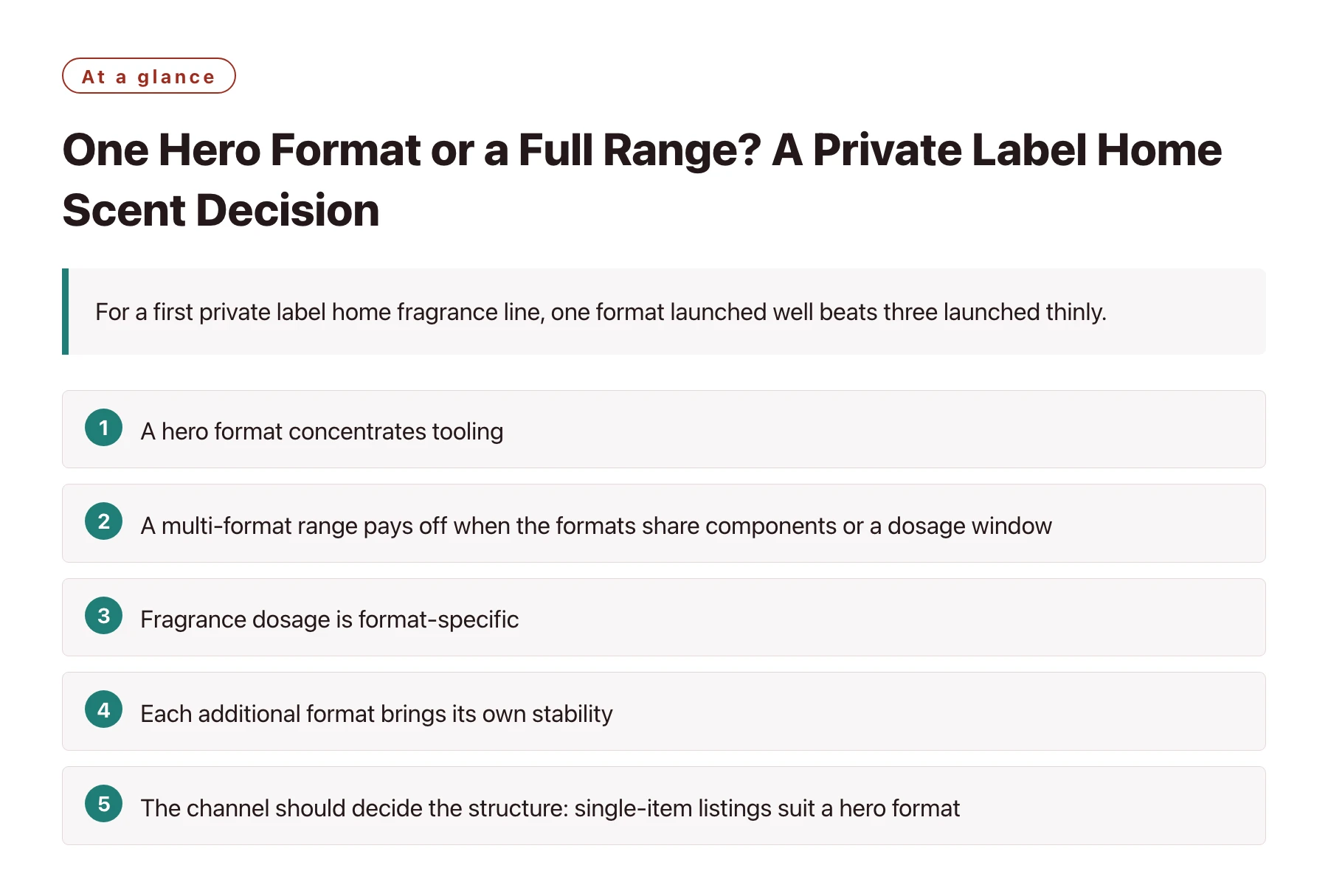
- A hero format concentrates tooling, fragrance approval and quality control into a single item, which is why it is the lower-risk route for a first home fragrance line.
- A multi-format range pays off when the formats share components or a dosage window, or when a retailer has already asked for a set rather than a single item.
- Fragrance dosage is format-specific, so the same oil has to be trialled in wax, in alcohol and on reeds before any range commitment makes sense.
- Each additional format brings its own stability, fill-weight and transport paperwork, and that file — not the oil — is where the surprise cost usually sits.
- The channel should decide the structure: single-item listings suit a hero format, while gift sets and seasonal endcaps suit a coordinated range.
The question arrives in different words every time — a candle, a diffuser and a room spray, or just one candle first — but underneath it is always the same question about where to spend a fixed budget. Private label home fragrance looks like a product decision; in practice it is a resource-allocation decision.
The two structures below are not good and bad. They are different bets, and putting them side by side on the variables that actually move is the fastest way to see which bet you are making.
Two structures, compared on the things that move
| Decision area | Single hero format | Multi-format range |
|---|---|---|
| Fragrance approval | One oil, one dosage window and one sensory reference to sign off | One oil adapted to several bases, so every format needs its own approval round |
| Tooling and components | One vessel family, one closure and one set of artwork to control | Shared vessels help a lot; mismatched formats multiply moulds, labels and freight units |
| Test file | A single stability and compatibility package on the finished format | A separate file per format plus a transport test for each configuration |
| Shelf story | One item has to carry the brand on its own | A range reads as a collection and gives the buyer a reason to take two items |
| Reorder economics | Volume sits in one SKU, so a second order gets cheaper per unit | Volume splits across SKUs, which can push each format back toward its minimum |
| Cost of a miss | A miss costs one launch slot and one component order | A miss costs the set, because the range is presented as a single purchase |
Read the table as a list of commitments rather than a scorecard. The structure that asks for fewer commitments is the one to choose while the brand is unproven; the structure that reads better on a shelf is the one to choose when a retailer has already asked for it.
Dosage is where a range gets expensive
One fragrance oil does not behave identically in every home format. A candle asks the oil to release from a wax pool at a particular temperature, a reed diffuser asks it to climb a fibre wick over several weeks, and a room spray asks for an immediate alcohol-borne burst that then settles down. The load, the carrier and the performance target differ, which means one brief can produce three formulas and three approval rounds.
This is the point where a private label programme stops being a catalogue purchase and becomes development work. When a supplier quotes a range, ask what percentage of the oil had to be reworked per format and what the cold and hot performance targets were. A quote that gives one number for three formats has not been through that work yet.
Compliance travels with the category
Fragrance materials are restricted by product category rather than by brand, and the published standards library is what suppliers work to when they set limits for a candle, a diffuser or a spray [1]. A range multiplies the number of category statements you need, even when the oil itself barely changes.
The vessel decision arrives earlier than expected
If reuse is part of the plan, packaging policy is already tightening: European packaging rules are moving toward reuse and refill obligations alongside recyclability, which makes one shared refillable vessel more attractive across a range than three disposable ones [2].
Components decide whether the range is cheap or expensive
A range is only affordable when its parts overlap. If a candle, a diffuser and a spray can share a glass family, a closure type and a carton size, the extra formats cost mostly fragrance and testing. If they cannot, you are running three component projects in parallel and paying three sets of tooling, print and freight minimums.
That is why the practical order is to sketch the components before the scents. Many home fragrance lines that begin with a hero format extend into a second format within a season or two, and the extension is easier when the first vessel was chosen with a family in mind. Product teams that want to see how a manufacturing partner handles that product logic before committing tend to start by reading a perfume factory in China and comparing what is offered in-house against what is subcontracted.
The second useful comparison sits at the programme level rather than the product level. Xuelei describes the model in which the maker holds the formula and the brand applies its own name to it — the fastest route to a first order, and the one that constrains range building least, but also the one where the same oil may already sit on other shelves.
A quick test before you commit: ask for the hero format alone and then the full range, both itemised. If the range answer is a single blended number, the extra formats have not been scoped yet, and the price will move once they are.
Sources
- IFRA Standards Library (International Fragrance Association) —— The IFRA Standards Library lists the restrictions the fragrance industry applies to individual fragrance ingredients, based on safety assessments; it is the reference point for compliant fragrance formulation.
- European Commission: Packaging Waste and the PPWR —— EU rules on packaging and packaging waste, including the Packaging and Packaging Waste Regulation requirements on recyclability and design.
Frequently asked questions
Is it better to launch one home fragrance format or three?
It depends on the channel. A single listing or a first market test favours one hero format, because the tooling, testing and approval work stays concentrated. A retailer asking for a filled shelf set, or a brand already selling into gifting, favours a coordinated range.
Can the same fragrance oil be used in a candle and a reed diffuser?
It can usually be adapted, but not at the same dosage. Ask for the load per format and for performance targets — cold and hot throw for the candle, diffusion curve and duration for the diffuser — rather than a single number covering both.
Why does a three-format range cost more than three times a single product?
Because components rarely stay fully shared. Moulds, artwork, print minimums, stability files and transport tests each multiply, and the second and third formats often carry their own order minimums even when the fragrance is identical.
How many formats should a first private label order cover?
One is the common answer, two when the components overlap heavily and the shelf asks for a pair, and three only when a buyer has already committed to the listing. The number should follow the listing, not the mood board.
Does a private label programme let me change the scent later?
That depends on the agreement. In a library-led private label arrangement the maker owns the formula and can supply it again; in a developed arrangement the brand may own it. Settle which one you are buying before the range is priced.